
Leadership, Height, and the Illusion of Clarity
There is an ancient proverb about drunkenness that reads less like a moral warning and more like a psychological case study.
It doesn’t describe intoxication as an immediate loss of control.
It describes it as a progression.
First, something attractive draws the eye.
Then it creates confidence.
Then it convinces a person that they are seeing clearly — even as judgment quietly slips away.
The proverb describes a person who feels unaffected by risk, who speaks boldly, who believes they are fine. It’s only later, when the effects wear off, that reality sets in.
The brilliance of this ancient wisdom is not that it condemns excess, but that it understands human perception. Intoxication works because it feels like clarity while it’s actually distortion.
And the image it uses to explain this could not be more relevant to modern leadership.
⸻
The Mast
The proverb compares the intoxicated person to someone who climbs to the top of a ship’s mast while the sea is rough.
From that height, the person can see further than everyone else.
They feel elevated.
They feel powerful.
They feel above it all.
But they are also alone.
Unstable.
And completely exposed.
The danger isn’t that they fall immediately.
The danger is that the height convinces them they are in control.
Height feels like authority.
Visibility feels like insight.
Distance feels like perspective.
But none of those things guarantee wisdom.
⸻
Modern Intoxication
Modern leadership has its own form of intoxication.
It isn’t alcohol or drugs.
It’s information.
Endless messages.
Constant notifications.
Dashboards, reports, emails, group chats, opinions, updates.
We live in a world that rewards responsiveness, speed, and visibility. Leaders are praised for being “across everything,” for replying quickly, for staying connected at all times.
But just as alcohol slows reaction time while increasing confidence, information overload creates the same distortion.
The more information we consume, the more elevated we feel.
The more elevated we feel, the less grounded our decisions become.
We begin to believe:
• that we see more than others
• that we understand more than we actually do
• that being informed is the same as being wise
It isn’t.
⸻
The Cost of Overstimulation
Information intoxication doesn’t usually show up as laziness or disengagement. It shows up as:
• constant fatigue
• short patience
• reactive decision-making
• shallow thinking
• reduced listening
• emotional flatness
Leaders don’t burn out because they don’t care.
They burn out because they never stop consuming.
The proverb warns that the intoxicated person doesn’t realise they’re impaired. They feel fine. They feel capable. They feel untouched by consequence.
That’s what makes intoxication dangerous.
In leadership, overstimulation often feels like competence.
Until it doesn’t.
⸻
The Deck
Ships are not sailed from the mast.
They are sailed from the deck.
From where movement is felt, not just observed.
From where people are seen, not summarised.
From where decisions are made close to reality, not filtered through layers of noise.
In industries like construction, this truth is obvious.
A short site walk often resolves more than hours of messaging.
A morning toolbox can prevent issues no email chain ever will.
Seeing a problem with your own eyes changes the quality of the decision.
Presence clarifies what information complicates.
⸻
Leadership Maturity
The ancient proverb isn’t calling for ignorance.
It’s calling for discernment.
Wisdom isn’t found in climbing higher.
It’s found in knowing when to step down.
Leadership maturity looks like:
• controlling inputs
• choosing presence over constant availability
• valuing grounding over elevation
• knowing that less noise often produces better outcomes
Clarity doesn’t always come from more information.
Sometimes it comes from creating space.
⸻
A Final Warning Worth Hearing
The ancient warning still holds true.
Anything that lifts confidence while dulling judgment is dangerous — even if it looks productive.
Anything that creates height without grounding will eventually distort perception.
The most dangerous leaders aren’t uninformed.
They’re overstimulated.
And the most important leadership decision may simply be this:
Where are you leading from — the mast, or the deck?
Roaming Chaplain
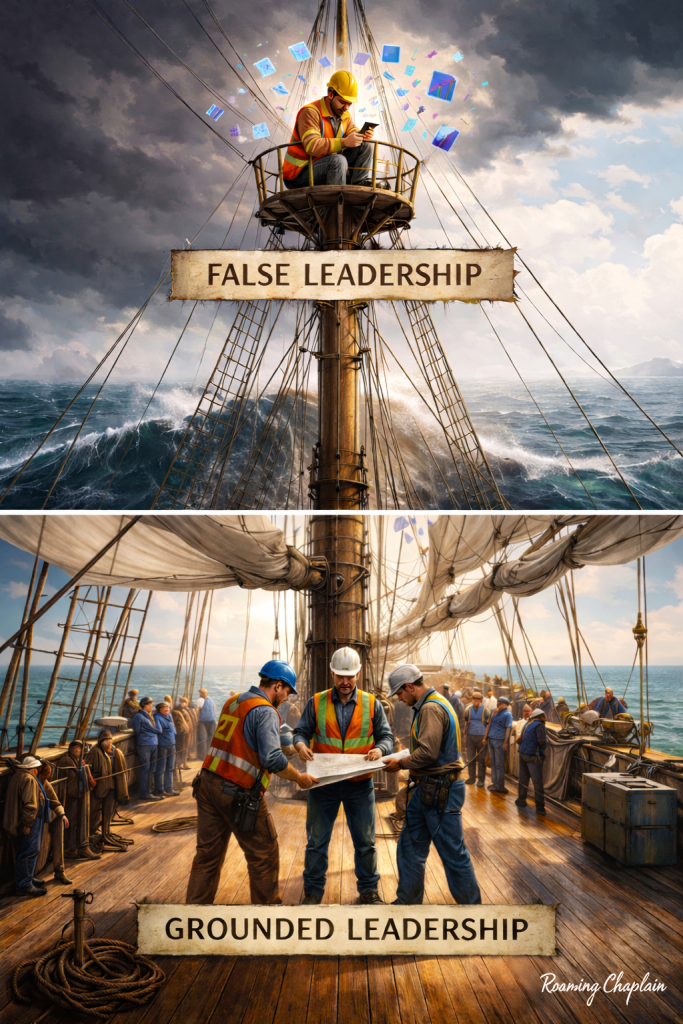
Inspired by the ancient proverb on intoxication and distorted perception — Proverbs 23:29–35 (ESV).


 Roaming Chaplain
Leave a comment